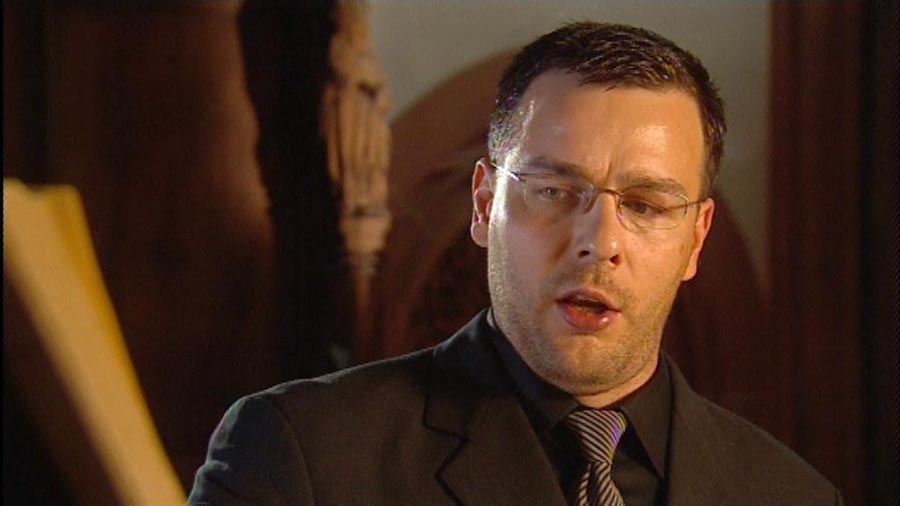
ANDREAS SCHOLL
ALGUNS ESCLARECIMENTOS SOBRE A VOZ DE CONTRATENOR
Andreas Scholl is best described as a COUNTERTENOR. He is ALSO correctly described as an ALTO and a FALSETTIST.He is NOT a tenor. He is NOT a castrato.
*
ALTO is the second highest VOICE RANGE and both men and women sing in it.
MALE ALTOS are also known as COUNTERTENORS.
FALSETTO is a TECHNIQUE used by ALL singers when appropriate and by countertenors most of the time.
*
FALSETTO is a voice production technique for singing high notes. It uses only part of the vocal cords plus the resonant spaces in the head and neck, rather than those in the chest and upper body. The longer the vocal cords (and men's are longer than women's) the easier falsetto is to 'do'. Using falsetto technique and head voice, a man can sing higher than if he used his full vocal cords and his chest voice.'Falsetto' has nothing to do with 'fake'. It is a musical addition to the normal - or 'modal' - voice. Untrained falsetto can sound awful, though (remember 'Tiptoe through the tulips'?) which is why it takes takes years of training to use it as sweetly as Andreas Scholl.Anyone can 'do' falsetto, male or female. Male pop singers use it all the time. Try it yourself. Press your hand flat against your chest and sing a bit of 'Thriller' like Michael Jackson or 'Barcelona' like Freddy Mercury - both falsettists. Go as high as you can without screeching. Your chest is hardly vibrating at all. You're singing falsetto, using your head voice. Now sing it as low as you can. Feel the increased vibration against your hand. That is is your more powerful chest voice. The audience may not even know when a singer 'changes gear' from chest voice to head voice because with training you can make it sound seamless. COUNTERTENORS AND CASTRATIA singer using falsetto is a falsettist. A countertenor is a falsettist who has trained intensively to sing in (usually) the alto range. He uses his head voice most of the time, not his chest voice. Not all countertenors sing in exactly the same range from the top to the bottom of their voices. One can sing higher or lower than another. Like all voice-type names, the word 'countertenor' was coined to distinguish this voice from, and position it in relation to, the tenor voice... above it or below it and so on.
*
ALTO is the second highest VOICE RANGE and both men and women sing in it.
MALE ALTOS are also known as COUNTERTENORS.
FALSETTO is a TECHNIQUE used by ALL singers when appropriate and by countertenors most of the time.
*
FALSETTO is a voice production technique for singing high notes. It uses only part of the vocal cords plus the resonant spaces in the head and neck, rather than those in the chest and upper body. The longer the vocal cords (and men's are longer than women's) the easier falsetto is to 'do'. Using falsetto technique and head voice, a man can sing higher than if he used his full vocal cords and his chest voice.'Falsetto' has nothing to do with 'fake'. It is a musical addition to the normal - or 'modal' - voice. Untrained falsetto can sound awful, though (remember 'Tiptoe through the tulips'?) which is why it takes takes years of training to use it as sweetly as Andreas Scholl.Anyone can 'do' falsetto, male or female. Male pop singers use it all the time. Try it yourself. Press your hand flat against your chest and sing a bit of 'Thriller' like Michael Jackson or 'Barcelona' like Freddy Mercury - both falsettists. Go as high as you can without screeching. Your chest is hardly vibrating at all. You're singing falsetto, using your head voice. Now sing it as low as you can. Feel the increased vibration against your hand. That is is your more powerful chest voice. The audience may not even know when a singer 'changes gear' from chest voice to head voice because with training you can make it sound seamless. COUNTERTENORS AND CASTRATIA singer using falsetto is a falsettist. A countertenor is a falsettist who has trained intensively to sing in (usually) the alto range. He uses his head voice most of the time, not his chest voice. Not all countertenors sing in exactly the same range from the top to the bottom of their voices. One can sing higher or lower than another. Like all voice-type names, the word 'countertenor' was coined to distinguish this voice from, and position it in relation to, the tenor voice... above it or below it and so on.
An 18th century castrato like Senesino or Farinelli did not need to use falsetto to sing alto (or sometimes even soprano) because neither his singing voice nor his speaking voice ever dropped to the usual adult range which for Andreas Scholl - and most men - is baritone. A castrato could use his whole chest and upper body because his vocal mechanism remained unchanged from boyhood: a high voice, but now delivered with a fully-grown man's lungs and body-strength. These days, no singer is deliberately castrated in the cause of music but there are a few endocrinological castrati whose physiology gives them the same combination of high voice and powerful projection as the 18th century castrati. They are very rare indeed.
Countertenors like Andreas Scholl can mimic the high voices of the castrati using intensively trained falsetto technique. Falsetto does not harness the chest-driven power and resonance of the castrati, some of whom could (it is thought) produce arena-filling volume like Pavarotti, although that wasn't the big thing, back then, when tonal beauty and expression were far more important. So, like the castrati, modern countertenors concentrate on producing different 'vocal colours' to express different emotions, and so convey the composer's and lyricist's meaning.
OTHER HIGH VOICES
A separate high male voice-type, the haute-contre - sometimes called high tenor - is a tenor who can sing higher than the usual tenor range but, unlike a countertenor, he does it using chest voice and head voice and sometimes falsetto, too, moving easily between them.
Some male singers, although not Andreas Scholl, sing in the soprano range. They are called sopranists and while they are often grouped with countertenors - because they, too, are falsettists - some prefer not to be called countertenors because they do not sing alto.Some female contraltos and mezzo sopranos can sing the same repertoire as countertenors, and vice versa. They can usually sing louder - and lower or higher - than countertenors because, like tenors, they use chest voice and head voice.
Some male singers, although not Andreas Scholl, sing in the soprano range. They are called sopranists and while they are often grouped with countertenors - because they, too, are falsettists - some prefer not to be called countertenors because they do not sing alto.Some female contraltos and mezzo sopranos can sing the same repertoire as countertenors, and vice versa. They can usually sing louder - and lower or higher - than countertenors because, like tenors, they use chest voice and head voice.
How singers are described can depend on what they are singing. A mezzo soprano who can sing low alto may occasionally be listed as a contralto if her repertoire in a particular performance is more usually sung by a 'true' contralto - that is, by one who who only sings in the lower (and lowest) part of the alto range. One old CD lists Andreas Scholl as a contralto. (Now that is unusual.)
CONFUSED? Well, it can get even more complicated, but this note is deliberately short and - haha - simple, as an introduction for the unwary. It's not a learned thesis and please don't write to us about fach. Just beware of saying 'Scholl's not a falsettist', as though falsetto were A Bad And Unusual Thing. He is, and it's not. It's just one technique among many used by all professional singers. Oh, and don't make the mistake of calling Andreas Scholl a castrato. You may bump into his daughter at a concert.
posted by Ludendi at
5:12 PM


0 Comments:
Post a Comment
Subscribe to Post Comments [Atom]
<< Home